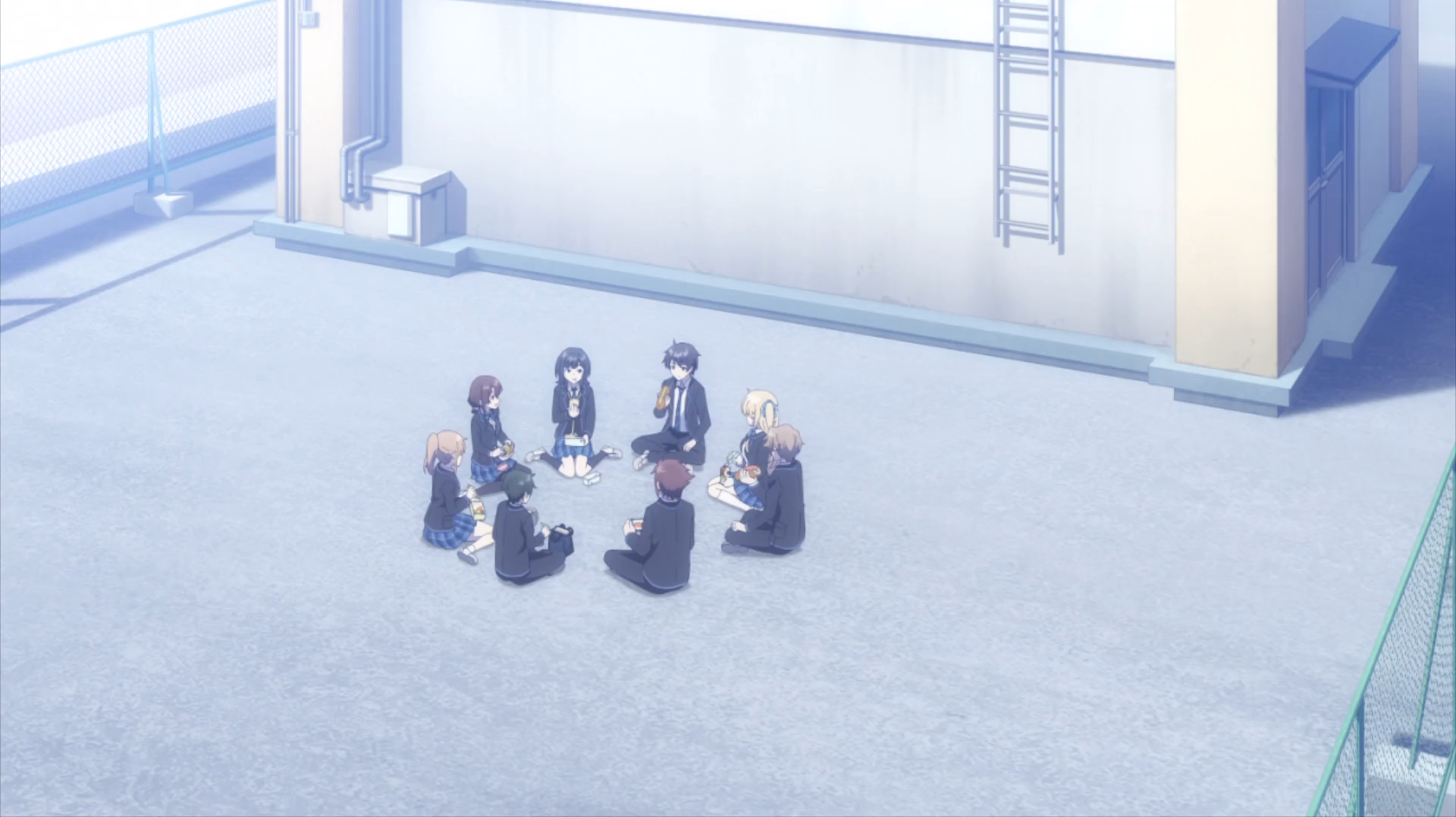
2012 r/dankmemes called, they want their anime back
You don’t need to be told that the world is a cruel place. War, genocide, famine, modern slavery, child labour, societal unjust is everywhere for those with eyes to see. Even in the most developed of countries, homelessness, addiction, and violence are so commonplace that no one bats an eye in case after case of tragedy. Where I live, the UK, heatwaves this year from fossil fuels-induced climate change have killed almost 2900 people in just two months, I cannot begin to imagine how lives are for people around the world who are vastly less well off. So, what does that have to do with a show about smoking anthropomorphised cat girls?
In Chainsmoker Cat’s universe, catgirls are viewed as the inferior race compared to man: humanoid mammals born without last names, go-to candidates for exploitative labour, and overall alien beings that are unserious, unhygienic, and unsociable. The attempt at social commentary is so palpable you can physically feel it oozing out of the screen. Not a second goes by without some mention of the disregard towards society’s permanent underclass, the discrimination towards minorities, or the disdain towards those suffering from addiction and mental health issues. The show’s social commentary is so palpable you can physically feel it oozing out the screen.
Yet, every facet of the show’s being rejects this reading. As if trying to appease the otaku zeitgeist, characters that lust over, objectify, and sexually abuse the catgirls are portrayed in a sympathetic (or at least humorous) light. The landlord’s omnipresent lust and the mangaka’s sexual/financial abuses are always played for laughs, and whenever given the chance, the camera prioritises tits and ass above all else. Seriously, I cannot stress this point enough: there’s no place worse to show young boys perving on cleavage or a landlord jerking it after seeing a tenant’s half naked body than a show that postures itself to highlight societal injustices. If there’s an attempt to make this to be the meta-layer of the allegory to stoke anger or reflection in the audience, it’s entirely lost in the omnipresent pee and poop jokes that make the mere thought of taking the show seriously nigh impossible.
Chainsmoker Cat accurate portrays the despair many experience in their daily lives. No one ever struggles from substance abuse, financial hardship, or racial discrimination because of their sole personal responsibility. The question is, what then? It does nothing beyond telling the audience that, yes, these things exists, and decides to stop there. Throughout the entire show, the catgirls are nothing but the butts of the jokes, and the punchlines just keep coming and keep coming and keep coming, as though if it ever slows down for just a moment to reflect on the issues it has presented, it will die.
Bibury has proven itself capable of creating something from nothing at all in the past. The stop-motion animation in episode 2 is a feast for the eyes, and its opening with references to various Kinos, though shallow, still lends an aesthetic sensibility that the show itself severely lacks. But the rot of comes from inside the house (pun intended). Chainsmoker Cat is a confused slew of childish humour, faux political rhetoric, and unapologetic fan service that no amount of eye candy can fix.
Now if you would excuse me, I’m tuning into BBC News and Al Jezeera to catch up on the very real tragedies that’s happening all around the world.
It is naive to think that one can write compelling fantasy without at least a basic understanding of history and politics. A fictional world isn’t just exciting because of its intricate magic systems, grandiose conflicts between kingdoms, or a hero’s triumphant journey; more pertinent to making a world feel lived-in lies in its dialectics: its systems of oppression and how the masses navigate them, its racial dynamics and how it affects every person’s class, wealth, and status, and how those social hierarchies then in turn shapes the characters’ every action.
Mushoku Tensei has shown from the outset that it does not care in the slightest about any of the latter, in huge part because of the 34-year-old reincarnated NEET lying in the centre of the story, Rudeus Greyrat. “Blessed” by the Hitogami’s divine interventions, he proceeds to gain immense powers as a mage in his upper-middle class family living in the wealthiest nation in the realm, diddling kids and buying slaves. But as bad as it sounds, as the turning points came and went, I found myself engrossed in the series despite the myriad character flaws of Rudeus, recognising the effort put into building an actually expansive setting not earthbound, but rather informed by its own fictional history and geography own society and the people in it.
I hate to pose as the enlightened centrist, but I’d like to offer a third way between much of the internet chatter between the relentless fans and haters, who’ve either praised it to high heavens or dragged it to the depths hell. A lukewarm defence of Mushoku Tensei, if you will. Unfortunately, though, this is also where I’ll have to put up a spoiler warning for this season, so beware beyond here.
Lovely family you got there Rudeus, would be a shame if a grey rat came and messed everything up
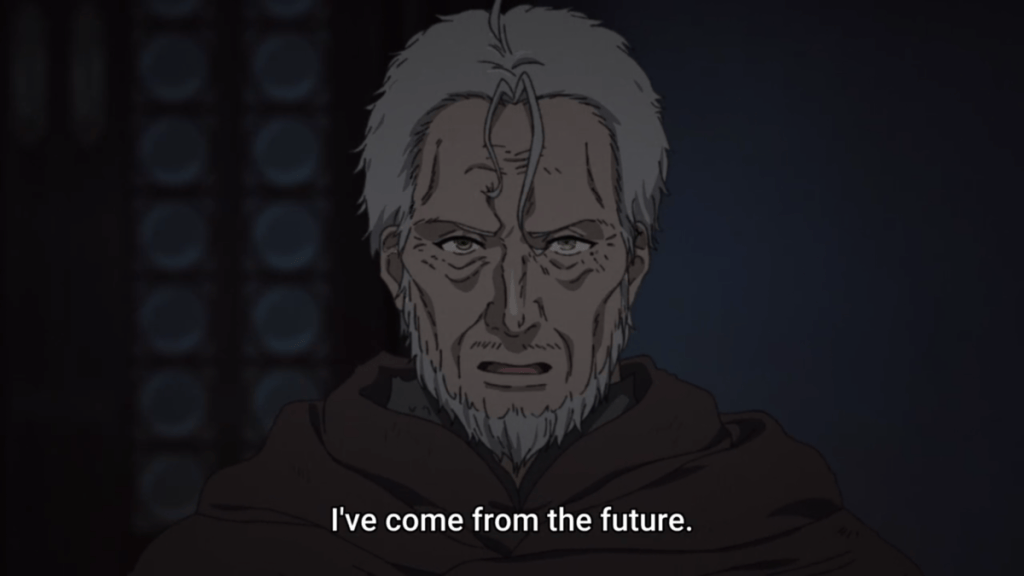
The one thing that Mushoku Tensei continues to deliver on, in spectacular fashion no less, is its wondrous, expansive world. Season 1 was a world building masterclass, an absorbing showcase of the geography, knowledge, and inner-workings of its world; season 2 provided a continued sense of simultaneity through reuniting the various friends an foes Rudeus has met all over to the Magic University, even as the world in view has shrank; and just as it felt like the pacing had grind to a halt after back to back slice of life arcs in season 3, it hits us with, without exaggeration, one of the most memorable and well-planned twists of all time. Alternative universe Oldeus’ brief cameo leaves behind a lasting sense of gravity that not only recontextualises all previous encounters with Hitogami, but carries consequences that ripples through the rest of the series, and one that will no doubt be remembered well through shock factor alone.
It’s a one trick pony, sure, but it is one hell of a trick. No matter what you think of Mushoku Tensei’s questionable morals, indistinctive female leads, or overall rancid vibes of its protagonist (and they are huge caveats, but we’ll get to this later), there’s no denying that it captures the imagination and satiates the thirst for exploration and the fantastical like no other. A lot of this is thanks to how profoundly relevant each detail and every story beat is, turning points or not: Ruijerd’s backstory seemed like throwaway material until it isn’t, Perugius’s castle in the sky was but a fairytale told to children until we get to visit 50 episodes later, and Nanahoshi’s understated by decidedly weighty appearance doesn’t make sense until her role in the story becomes clear.
The pinnacle of it all culminated in this season’s turning point. Think back to the times when Hitogami actually appeared in front of Rudeus. First when convincing him to bring Ruijerd Superdia together on his journey, then desperate interferences (naming their team Dead End to scare Roxy away, advising him to find the demon eye to make sure they don’t cross paths, and bring along Ruijerd just as insurance) at Wind Port in the Demon Continent so they would brush pass each other, and his recommendation to stay in university to marry pet duo Lineana and Pursena in lieu of reuniting with family and friends in the Begaritt Continent to save Roxy and his mother. With Turning Point 4, everything snaps into focus. These moments of anagnorisis are what makes Mushoku Tensei, but whether it is makes up for all sins is another conversation all together.
Know that although I’m about to take huge digs at the show, Oldeus is a brilliant addition that I haven’t been able to stop talking about ever since I first read it three years ago
When the show does retreat back to the daily lives of its characters, especially Rudeus’, it can’t help itself but let the rampant misogyny and general conservative bigotry seep in. The warning signs were early and plenty—from grooming to paedophilia, to slavery to adultery—Mushoku Tensei really wore their politics up their sleeves, intentionally or not. What makes season 3 the tipping point, however, is how so much of these (with the benefit of the doubt) “subconscious” leanings have come home to roost and affected the quality of it’s world itself.
This is where I risk a controversial opinion: despite the many hardships the story puts Rudeus through, its world ultimately accommodates all of his worst traits. Yes, it’s true that the challenges he faces are of epic proportions and the consequences for failure harsh. First teleported from his sheltered family home in lush fields into the barren land of demons, then brutalised and murdered by the embodiment of terror in their trek back home, followed by losing his father in a strenuous dungeon crawl to save his amnesiac mother, and to top it all off antagonised by the literal god of the universe and has his entire family killed in an alternate timeline. These are great narrative tools, not least because of their scale and stake that helps invoke a sense of otherworldliness, but it’s also a moot rebuttal to the actual point I’m trying to make.
Namely, everything is infinitely malleable so long as Rudeus gets to be seen as a sympathetic, popular figure. Slave trading is fine, having sex with under-aged children you groomed is fine, cheating on your pregnant wife is fine. When considered individually and with an unreasonable amount of good faith, they could be treated as part of the quirks of world building, since there are sufficient Thermian justifications for all of the above. But once you notice the pattern—that the world bends to his will and enables everything that’s wrong with his character—you can’t unsee it.
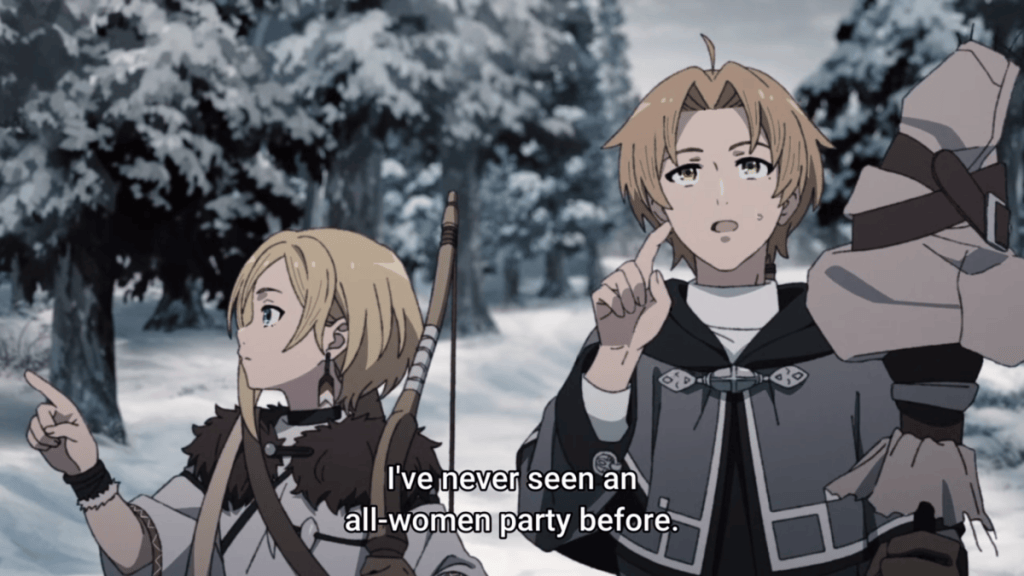
“I guess you stop seeing them over rank C people look for skill over gender”, Sara added. Just some casual misogyny thrown in for no reason whatsoever
Calling Mushoku Tensei a story of Rudeus’ redemption is beyond disingenuous because, in this six-faced world, he does not need to learn. Sara’s saga comes to a close this season by feigning the “growth” Rudeus, but the show somehow tries to put part of blame onto her too. Which is ironic given the constant commentary from Mr Gin-san. Other than the side affect of treating the audience like complete idiots who can’t read the room by spelling out every single little emotional detail, the mere sound of his voice is a constant reminder that Rudeus is a 34-year-old man reborn who should know better, whereas at the opposite end is a girl deep in the teenage angst, hurt by her horrible first experience.
But the worst victims are no doubt his wives/love interests, who are now caricatures of their past selves devoid of any character. Sylphy is monogamous until her darling says no, and henceforth turns into the polygyny advocacy demon; Roxy is an authoritative figure only in name, but is otherwise reduced to a petite woman who exists solely to praise and elevate Rudeus’ abilities by comparison; and even when miles away from Rudeus, Eris’ entire schtick is idolising a predator, even improving on her sword skills involved thinking about him, truly one of the lamest fails of the Bachdel test in recent memory. While thankfully Eris isn’t doomed as a character (yet), Sylphy and Roxy has already permanently brain broken post-marriage that conforms to Rudeus’ desires, of cute, subservient, and loyal wives.
To portray these tropes so uncritically are already inherently harmful, but even if you’re the kinds of nutters that doesn’t care about the real life implications of fiction, they diminish the very magic that its world holds. The allure of great fantasies is that its imaginative setting allows for thematic explorations from different perspectives, but when the characters and narrative constantly endorses the oppression in real life, with its form and function unaltered, its effectiveness inevitably fades. Mushoku Tensei world is, again, admittedly impressive. But dare I say, it does less than nothing with it, and that’s all because the author’s (or lack there of) beliefs.
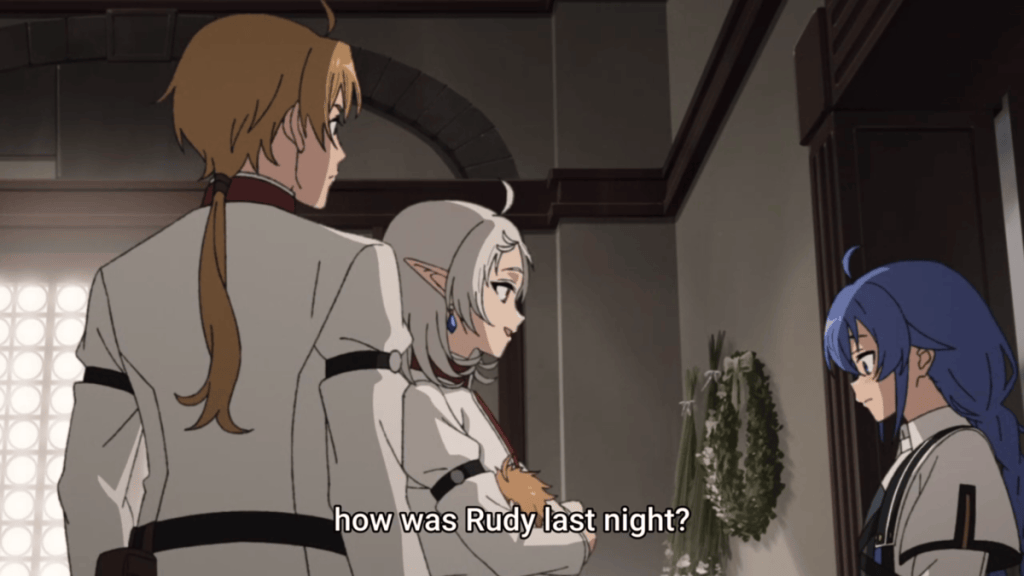
Like, how can you not wince at this scene of Sylphy asking Roxy how sex was with Rudeus last night?
I don’t claim to know for sure Rifujin no Magonote’s politics, but if I were to make a profile of him, it’d be this. This is a man who is shaped by his narrow media palette (i.e., male-oriented otaku subculture) and has never stopped for one second to consider that perhaps his biggest influences are not an all-encompassing and neutral force, but rather informed by very real material and ideological contexts. The result is an anime that feels increasingly flat, even as our heroes are meeting new and reuniting with old friends and foes alike; because by adopting so many of the medium’s tropes unfiltered, every second in its world is becoming a reminder of reality: it is becoming ordinary.
Yet, despite everything, I can’t help but find _Mushoku Tensei_ somewhat endearing for what it is: a snapshot in time of a landscape now lost. Nowadays, the sludge that comes from deriving from Narou-kei no longer even pretends to say or do something profound and elaborate.
Even if only for all its fantastical twists and turns, this six-faced world is still worth witnessing till the very end.
The rules of the Aishiteru Game are simple: your heart flutters, you lose. Generations of romcom authors (competent and incompetent) recognise the limits of the concept as a plot device, but not the author of I Want to End This Love Game. The game relies on one’s inability to put on a poker face or the honourability of the loser, that’s why it’s a game played by children at school or adults at bad parties. Extending the span of a game designed to be won in minutes if not seconds to YEARS is a disaster in waiting. Every of this show basically goes like this: Yukiya/Miku tease the other –> Yukiya/Miku get the butterflies –> Yukiya/Miku refuses to admit their very obvious reactions –> repeat. Often, two three times an episode. From eating lunch together at school to playing video games together to “fake dates” to staying over, everything gets filtered through this narrative loop, killing any and all momentum from any genuine chemistry the two leads have dead in its tracks.
The show does redeem itself later on with another one of Japan’s quaint party games, the Pocky game. After 10 episodes of blue-balling its audience, the author finally decides that some drama is due and gets Miku jealous enough to kiss Yukiya under the thinly veiled guise. And ironically, an unintended consequence of its matrix of horrible writing decisions—depicting so much of their flounderings and pointless detours—is this intense juxtaposition of progress that cuts through both diegetically between our main duo and also the meta layer by the audience. I Want to End This Love Game manages to carry this momentum to the very end. As the two start their final Aishiteru Game of the season, the same “I love you”s are said, the same denial is given, yet something feels different. Gone is the awkward wheel of doom that they pedalled on week after week, instead, Yukiya and Miku grew closer, finding a new balance of the relationship upon where a new but the same old game is played.
“I have seen people online describe I Want to End This Love Game as ‘Walmart Kaguya-sama: Love is War‘, but that’s a disgrace to both the supermarket giant and Akasaka’s magnum opus.” That was my planned, harsh and original opener when the show first aired. But once it grows out of the Aishiteru Games, it becomes increasingly clear that there is something more it has to say. Your teenage years are a constant negotiation between mind and senses, spent running around in circles mindlessly chasing things that are already right in front of you. And while I Want to End This Love Game had failed to make it entertaining, if its purpose is to present the frustrating, the embarrassing, and the endearing of adolescence, making you dwell in thoughts of the past, it has passed with colours. Perhaps not flying, but grounded colours.
It’s rare that I find myself at a complete lost for words for a show that I absolutely adore, yet, Botan Kamiina Fully Blossoms When Drunk’s what I can only describe as blinding radiance is so exceptional as to be paralysing. Cerebral yet straightforward, poignant yet cheerful, brutal yet kind. From its careful choice of motif to the sprawling exploration of the psyche, it embodies the human condition in cute anime girl form, standing defiant against the hallmark issue that haunts its spiritual foremothers.
CGDCT has its gems no doubt, but one prevailing problem plaguing the genre has always been its insistence of chastity to the point of farce, and the distaste of manufactured inauthenticity that comes with it. Botan Kamiina Fully Blossoms When Drunk, on the other hand, borrows every tool in the conventional toolbox to imitate aesthetics and style, but uses it to subvert expectation and weave a satisfyingly interwoven package. The result is a pastiche that eludes categorisation, it’s CGDCT without the suffocating cutesiness, Iyashikei without the farcical naivety, and Yuri without the extravagant dramatics.
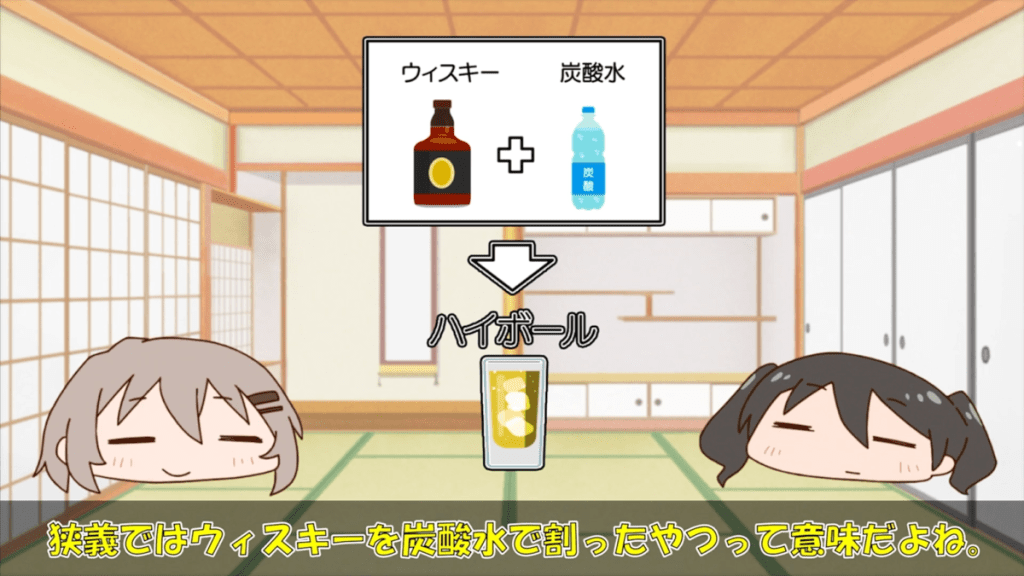
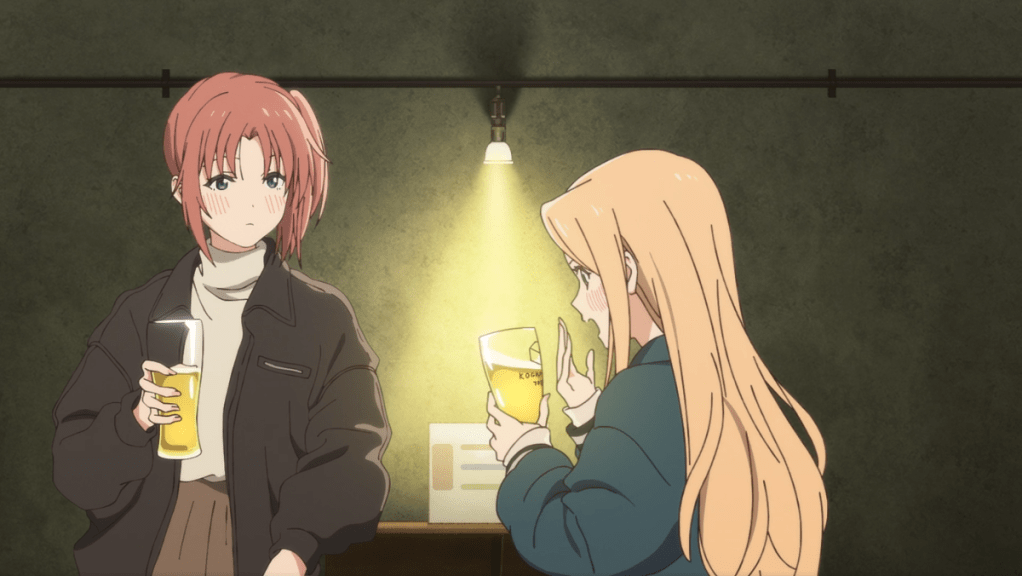
Highball: in Japan, synonymous with whisky and soda, rather than an umbrella term for a combination of spirits and mixers. Thank you Aoi and Hinata from Yama no Susume
Yet, even as its genre roots would suggest otherwise, Botan Kamiina Fully Blossoms When Drunk interfaces with the subject with a level of sincerity rarely seen elsewhere. Constantly invoked is the idea of the Dutch courage, giving our cast an on-ramp and off-ramp for initiating intimate conversations, teasing advances, and honest confrontations, all the while casting a shadow of doubt over the genuineness of their actions. The show consistently plays with this unique dynamic to paint, for lack of a better word, Schrödinger’s cat-ness of the mind, capturing the the contradictory of being through not just thoughts, but also in the way the characters behaves.
Kanade’s oxymoronic relationships is the cornerstone of the show in this regard. It’s her sincere friendship with fierce romantic rivalry Botan, the film-watching, game-playing, whiskey-infusing while talking about their common crush. It’s the awkward but still close and friendly terms with Ibuki, the hikes and catching up over drinks even after the brutal rejection. It’s the affinity but hesitancy when it comes to Jinran, the stiff flirting and deep, sombre talks at the bar. And ironically, its by putting on display this complexity of the psyche—the peppy, the wistful, the melancholic simultaneously—that relationships between the characters and their daily lives become that much more lived-in, authentic, and potent than compared to its peers.
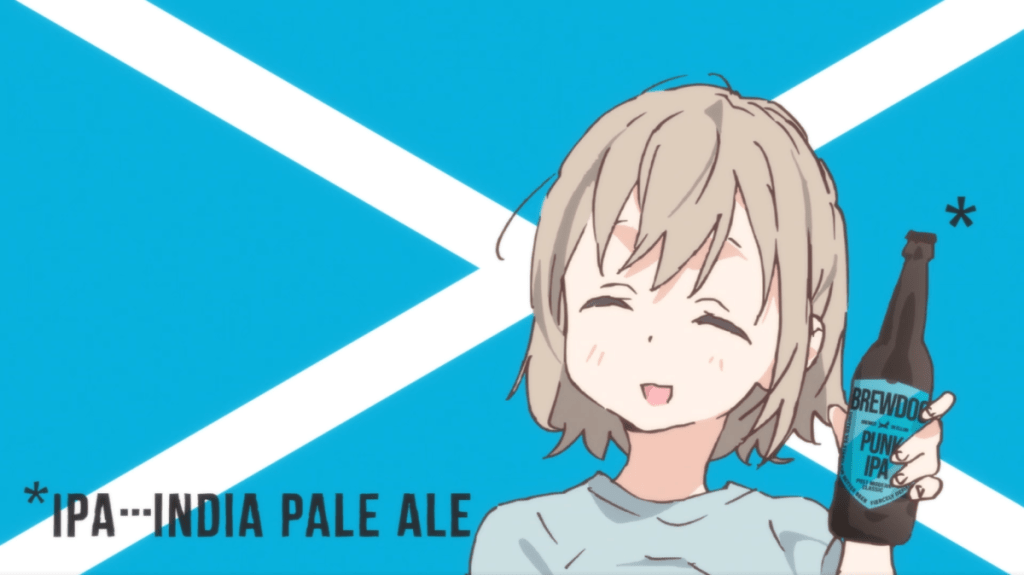
Punk IPA: flagship beer of British brewery and pub giant BrewDog, infamous for its overpriced menu items and horrendous treatment of its workers
Despite its monolith of a central motif, however, the show’s portrayal of life is, true to form, opaque and disjointed. Completely missing is any semblance of a unifying plot: a common goal that the cast is working towards together, a shared interest that everyone bonds over, or a school club that they are all part of. Instead, it’s completely reliant of on anecdotes and respective themes ebbing and flowing that, again, epitomises the experience of adulthood.
Where Botan plays the role of the “incorruptible soul” stereotypical of the genre, her purity acts not as a healing force that rids unkind thoughts, but a mirror that leads others face what her relentless earnestness reflects inside them. Be it Ibuki’s trauma, Kanade’s jealousy, Yaeka’s over-possessiveness, or Akane’s apprehensions, Botan’s beaming presence is both precious but also emotionally demanding. Attempt after attempt after attempt, Jinran gently waltz into Kanade’s heart with the aid of alcohol, but it was their shared appreciation of the arts that gave them the final push to set sail. And despite Yaeka’s personal grievances about Akane’s obsession with music, she also adores her passion and supports her pursuit, always there to chase her gloom away.
Botan Kamiina Fully Blossoms When Drunk manages to skip between these vastly different subjects in a decidedly coherent manner. It achieves this by deliberately obfuscating the characters’ state of mind: scenes told without internal monologue, catch-22s present that renders choices a futile exercise, trains of thought literally cut off and stopped midway in its tracks. Leaving true intentions up for interpretation allows the show to be about everything, all at once; the liminal spaces between themes connected through this lingering sense of inconclusivity, creating this hyper-literal art-imitates-life narrative that it’s difficult to put into mere words.
Weizenbier: aka wheat beer, brewed by replacing portion of malted barley with malted wheat, resulting in a lower IBU. In the picture, “Forest” brewed by Bathe Yotsume Brewery
Where words prove profoundly inadequate, the amazing team of animators with Soigne’s bohemian attitude towards the industry norm of consistency has filled in the gaps. The visual language of Botan Kamiina Fully Blossoms When Drunk drives much of its characterisation and the depth of its world. It boasts on social media (Twitter/X) and blog posts about the scouting of actual locations featured, but more importantly, the wide array of talent and changing roster weekly, and it’s not hard to see how each of the teams’ idiosyncrasies elevates each and every episode.
Miyachi’s principled attitude towards character design in episode 1 sets the solid foundation to build on; Matsuo Yuusuke’s solo key animation with their signature free-flowing line work and tactfully exaggerated character movements in episode 2 magnifies expressiveness and moe, a subtle but substantive change that lures in audience further; Gin-san’s avant-garde, Shaft-esque style in episode 3 throws a spanner into the works, but manages to maintain the main duo’s emotional distance while encapsulating the peculiar energy of its source material; Makimo Hidenori’s gorgeous renderings and Tozawa Shuntarou’s jaw-dropping storyboards and blocking in episodes 4 and 5 rises to the occasion for the two most dramatic episodes of the series yet; Morotomi Naoya her key animation team’s liberal take on facial expressions and character movement in episode 6 serves as the perfect showcase for Jinran’s first appearance; Kuremizu Kousuke’s use of ambience and the background of the everyday to echo characters’ mood in episode 7 helps fill in the gap where dialogue couldn’t; Okubo Shunsuke’s more mature rendition of the cast in episode 8 is a match made in heaven for its tonal shift towards tackling the real worries of grown-ups; Shirasaka Hideaki’s script combined with Tanaka Hironori’s role as storyboarder, animation director, and episode director provides the concentrated vision needed to deliver the climax that is episode 9; Okuda Yoshiko’s exquisite lighting paired with Matsumoto Norio’s amazing character animation in episode 10 gives off a subdued vibe fit for both the flourishing romance between Kanade and Jinran as well as the quiet grudges and confidence that defines Akane and Yaeka’s relationship; Ueno Souta’s out of this world backgrounds and bold shot composition in episode 11 captures the feeling of blooming love between our now two couples; and the whole team coming together for the powerful finale in episode 12 is nothing short of poetry in motion.
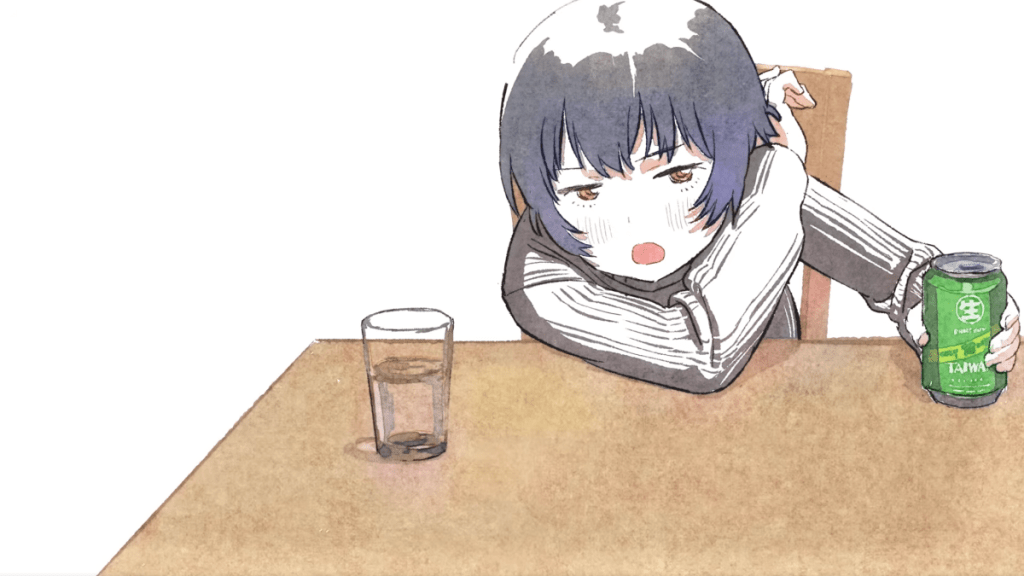
Taiwan Beer: produced by state-owned Taiwan Tobacco and Liquor Corporation using short grain Penglai rice, imposed to the island during Japanese rule during WW2. But still, please go try their Lychee fruit beer, truly out of this world. Please go try their Lychee fruit beer, truly out of this world
Beyond its production masterclass within its 20 minute runtime, Botan Kamiina Fully Blossoms When Drunk further reinforces the three-dimensionality of the cast and world with its crème de la crème 4:3 opening and 12 unique water coloured endings by Yoshinari Kou (episode 1’s below). At the end of each episodes are 90 seconds of dazzling sequences that exposits backstories and hints at small details for keen eyes to follow. This approach lets the show have cake and eat it too. It avoids being too bogged down by exposition without sacrificing character depth, all the while the reality of never being able to understand someone except from the stories they tell you.
I won’t bore you by going through them one by one again, but it would be criminal to not to highlight some of the standouts. The ending of episode 5 tells the tale of Kanade and Ibuki’s first meeting, how Kanade finds and loses her colourful world. But within it also are references galore: Kanade’s camcorder used for recording the OP, the aftermath of Ibuki’s traumatic experience first shown all the way back in episode 1, Botan and Kanade’s shared first impression of Ibuki in episode 4, the same shot of Gifu mountain later hiked in episode 7. The ending of episode 9 shows the prelude episode 5’s B-part, juxtaposing and parrallelising Botan’s confession that just passed with Kanade’s to great effect. Not to mention the various endings that fleshes out Kanade, Akane, Yaeka, Jinran, and Ibuki‘s past.
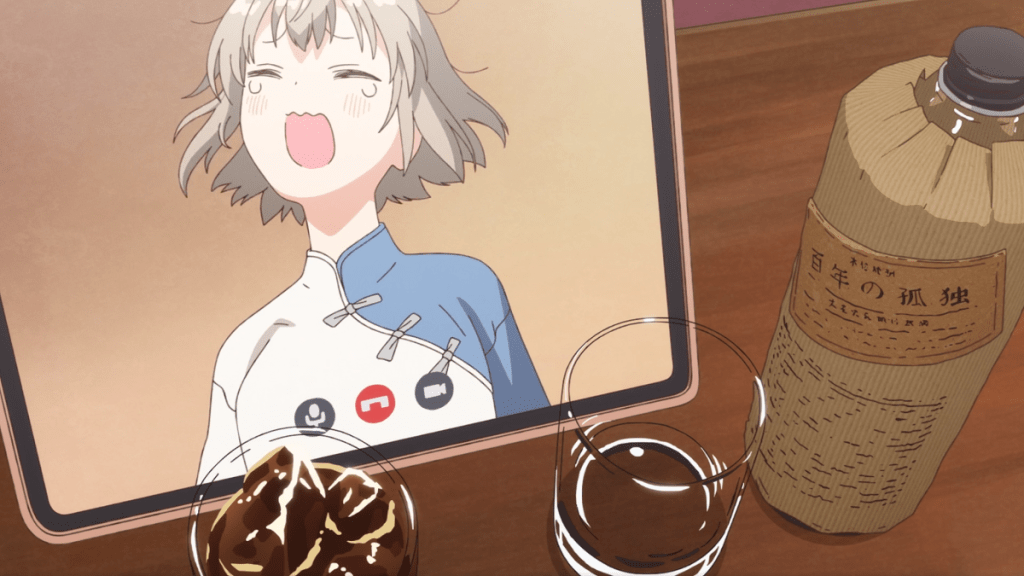
Hyakunen no Kodoku: A brand of pure barley Shochu brewed by Kuroki Honten in Miyasaki, est. 1885. I would add a snarky comment except I know nothing about this drink.
It’s rare that I find myself at a complete lost for words for a show that I absolutely adore, and it is not lip service. Three scrapped drafts later is what you have been reading right now, an unfiltered, hazy, and jumbled rumination. But if there is one takeaway from Botan Kamiina Fully Blossoms When Drunk, is that life doesn’t wait for perfection. Accept your foibles, come to peace with failings, and move on. A beautiful world still awaits.
It reaches for the moon, but can’t bring itself to leave Earth behind
In a more well-respected medium, Chitose Is in the Ramune Bottle probably wouldn’t have had to face as much backlash as it did back when it first aired. With the litany of repulsive goon slop out there, it’s an understandable reaction to treat its 30-minute premiere as a failed attempt at satirising contemporary otaku-isms. Between the cheerful cast yelling nonsensical greetings to each other, to the three heroines practically confessing their love to Saku, to our hero’s bombastic break-in to cap off, it’s hard to put into words how obnoxiously loud and stupidly thick the introduction really is. But frankly, I think that’s what makes it charming.
Episode one quite literally ends with our protagonist destroying his classmate’s bedroom window.
The central problem Chitose Is in the Ramune Bottle faces is the existence of its shitty peers. The sheer infamy of works like Oreimo or Haganai or Henneko or The Ryuo’s Work is Never Done or Eromanga Sensei or Imoimo or Hensuki or Tsurekano or The Angel Next Door Spoils Me Rotten or Kimizero or Roshidere or Kurakon or Danjoru or Imouza, just to name a few, inevitably prompts skepticism towards any work that shares the “light novel romcom adaptation” label. Yet, it pays no attention. The show unashamedly employs character cliches in the genre both ironically and genuinely; it draws on the “popular guy = bad” trope as a major narrative driving force, just to break it wide open with the main cast’s deep sincerity and compassion; and it embraces teenage naivete and the naval-gazing, self-important philosophies to contrast with Saku and friends sociable front.
This post-ironic approach lets the show eat its cake and have it too. By ingeniously relying on paratext to setup a fake veneer, it saves a lot of ink on exposition while also allows it to hide its true intentions: the seemingly stereotypical characters offer comfort in familiarity for the less adventurous, afford the narrative space to jump right into action without having to establish chemistry, and subvert audience expectations as each of the boys’ and girls’ masks slowly slip.
All that is to say, it doesn’t take a genius to catch on to the mountain of contradictions Saku & co. contend with, and arrive at the conclusion that something is brewing under the surface, even in early episodes. The most apparent departure from the conventional is that the show constantly and deliberately understates anything important that informs the cast’s personalities. With the story starting in the second year of high school, the usual back story dump that plagues the genre is curiously missing, and any effort to bring it up is immediately shot down. This lack of any significant mention of past events for a story that starts in media res creates gripping, organic intrigue that lingers in the back of one’s mind.
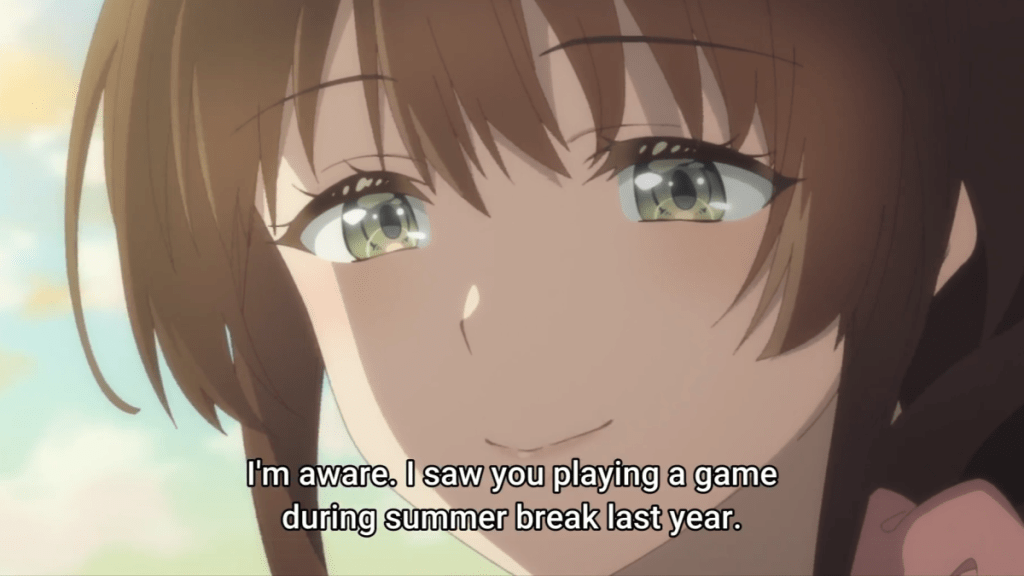
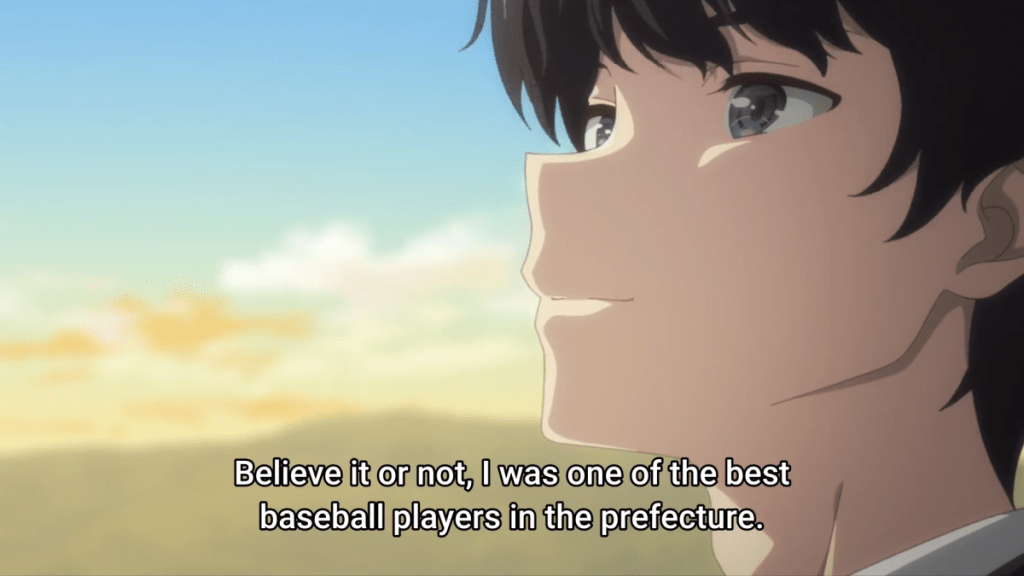
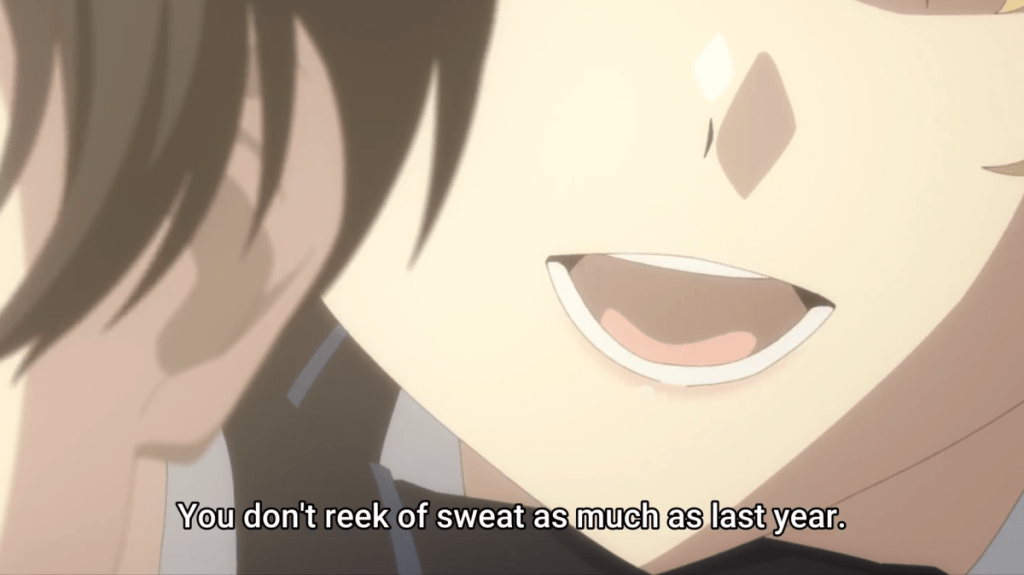
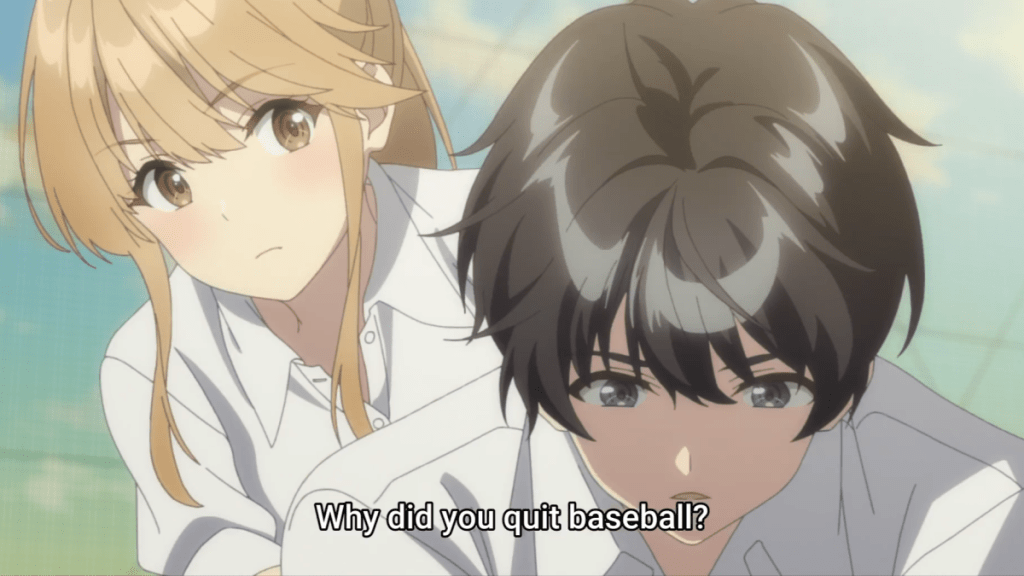
The most prominent example is the paralepsis surrounding Saku’s relationship with baseball, which remains a mystery, but the intention to return to this plot thread is clear. From top left to bottom right: Yua, Hiiragi, and Haru all commented on it.
Indeed, as the show gets to more serious themes/arcs, it recontextualises the material before it and elevates the work as a whole. Whether it is from Nanase’s PTSD and the evergreen question of the line where the platonic ends and romantic starts; or Asuka’s struggle with parental expectations and the anxieties of breaking out of your own bubble; or Saku’s fragile facade and his wrestle with the concept of Honne/Tatemae that envelops it all, we come to appreciate the odd parts as genius: interactions feels performative at times, because to a certain extent, it is. The whole charade is a flamboyant act the whole group puts on in order to hide their insecurities and the brittle nature of their dynamic; and Saku’s foolish, in-your-face idealism and philosophical waxing was never Chitose Is in the Ramune Bottle’s central thesis. Rather, the show goes out of its way to actively disprove such an unsustainable way of life.
It’s a bait-and-switch. Kenta’s and Yuzuki’s arcs aren’t pointless exercises, but an noble solution a central issue with all of fiction: that your message basically never reach those that aren’t already looking. Everything from episode 11 onwards is a great wakeup call to those that unironically enjoyed what was presented to them on the surface. Ultimately, instead of aligning itself with the “popular kid” escapist fantasy, the show flips the script to depict the common struggles of riajuus (aka, let’s face it, your average teenager) that are often much more complex than contrived McGuffins or the tired “love me, love me not” flounderings. The humanity it presents is perhaps ordinary, but a much-needed breath of fresh air in the landscape.
Sadly, there’s just no room for charitable readings.
Context is King, and in an environment as toxic as this, any perceived misstep is a deathblow to whatever crumbs of confidence is left. The unfortunate reality is that, through guilty by association, the many brave choices Chitose Is in the Ramune Bottle made can also be readily (and reasonably) dismissed as mere authorial blunders/laziness. The natural interpretation of Saku’s genuine internal conflict, of living out the ideal and reconciling self-image with societal expectations, is but your typical chuunibyou bull; his “harem” acting like the whatever-deres you care to mention only reinforces this exegesis; and the admittedly absurd ending in episode one might as well be the titanium bolt on this stainless steel coffin.
This is not to blame the script’s problems all onto the extrinsic, however. Arakawa Naruhisa is a veteran of the industry and should have known better to adapt the novels into something more fitting for the weekly TV format. To this end, it’s hard not to get into suggesting easy improvements:
Drop the descriptive slurries delivered by Saku’s internal monologue. While the prose is a standout in the original novels, visuals and voice acting could have done the brunt of the work with the change in medium. The omnipresence of Saku’s thoughts, important and trivial, is a symptom of failing to “kill your darlings” and diminishes the impact of moments where his thoughts do have significant bearing to the story.
Play the first four episodes at once to soften the shock from the gamble that is Kenta’s arc. The first volume mirrors the structure of the show as a whole, itself being a post-ironic bait-and-switch that compliments its central message (of not judging others by first impression) well, which works well as a single volume, but falls short when split into a story in 4 parts.
Cut the unadulterated fan service scenes that only serve to muddle the waters.
But where parts of the weak script set it back, Chitose Is in the Ramune Bottle makes up for by doing visual storytelling well via great character acting and purposeful cinematography. At risk of committing the sin of the blue curtain, this washed out, almost artificial blue tint that the cast constantly basks under works as great visual metaphor for their unnatural relationship and symbolises an underlying sense of melancholy. More explicitly, important scenes are emphasised to get the point across succinctly without dragging down pacing or making things agonisingly obvious: focusing in on Asuka’s eyes lighting up during the flashback in episode one, Nanase flinching at Saku’s playful feint chop in episode five, or Saku’s suspicious eyes in episode six, for example, comes to mind. And even more so, the ED paints a vivid picture of Saku’s younger self that echoes his talk with Kenta in episode two, a big red flashing warning sign asking the audience to look beyond a purely textual reading of the story.
creditless ending
It’s a slight shame that the production values aren’t consistently great and there isn’t an impressive flair one can point towards. Although both the OP and ED are audio-visual treats, production masterclasses like Makeine and My Dress-Up Darling have shown the ceiling of what’s possible for the genre and Studio Feel is simply no match. Facial features go off-model on occasion, movements are decent overall but are sometimes stiff in the usual way that seasonal anime almost necessitates (the football scenes come to mind), continuity rarely but do sometimes break in between cuts, and the occasional shot could use with a little more thought.
Exhibit A on the last point: a nod to deco*27’s Monitoring in episode one is cute but doesn’t work in-universe. (There’s no peep hole on Kenta’s door)
Alas, he who fights with monsters might take care lest he thereby become a monster, and Chitose Is in the Ramune Bottle clearly didn’t take enough care; that much is said in earlier parts of this review. But I’m praising with faint damn here, those who are quick to judge are missing out on a story that’s more introspective and intricate than it is on the surface. It ambitiously utilises its contradictory nature for characterisation and narrative realisation, crafting a story that captures the adolescent beauty/chaos in its very essence. And looking at recent seasonal charts, I feel the effort alone should be commended, if all else fails.
My Friend’s Little Sister Has It In for Me! has it in for me
In the early 2000s, prominent cultural critic Hiroki Azuma observed that the otaku media diet is slowly animalising: grand narratives were slowly being abandoned for categorised consumption, personalities of characters becoming mere data points to be sorted into a personal database in the mind of the otaku, each entry granting a little dopamine hit evolved from our primitive ancestors who survived nature better through pattern recognition.
So, you might be asking, why am I bringing up Azuma’s seminal theory on postmodern otaku culture in a review about My Friend’s Little Sister Has It In for Me!? It’s because every element of this show is designed to invoke this animalistic reaction of categorisation. The character, the narrative, the sound design, the OP and ED, the visual presentation, everything serves to deliver those sweet sweet dopamine hits.
Tune into an episode of My Friend’s Little Sister Has It In for Me!, and the first thing you’ll see is a barrage of exclusively contemporary otaku-sphere references splattered onto its OP. I cannot stress this enough—this is the most repulsive, unoriginal, unharmonious opening sequence I have ever seen, period. Ace Attorney, Kyoufuu All Back, the Twitter Bungo Cat reaction gif, Minecraft, Jojo’s Bizarre Adventures, Pacman, Street Fighter, Suika Game, all used thrown together with the intentionality and care of McDonalds fries, which is, ironically, the first scene of the OP. They even showed cleavage three different times in there just in case you live like a caveman and miss all those references.
After getting through that 90-second hellscape, you’re greeted with our completely sauceless protagonist, Temu Takagi-san main love interest, a paedophilic teacher, and a cast of (to put it in the nicest terms possible) clinically autistic supporting characters. Each of them a wet sock devoid of any real internal struggles or personality, except for their contrived and imposed personality traits coated in a thick layer of irony, with the sole purpose to deflect criticisms.
If you think the setting and plot couldn’t be any worse, oh boy aren’t you in for a treat. It all starts with a fake-dating story line, protag-kun Aki (who’s a genius game developer that makes the big bucks) was threatened into fake-dating his osananajimi (who’s a genius best-selling author that writes the plot for the games under an alias) by her rich uncle (who publishes his games), or face divine retribution (his uncle will refuse to publish his game). Meanwhile, we get to know that he had blackmailed his paedophilic teacher (who’s a genius best-selling doujin artist) into drawing art for his game. Half a dozen episodes of faffing around later, Temu Takagi-san Iroha (who’s a genius voice actor that voices every single character for his games) eventually gets jealous of the fake-dating and stops doing his job properly. Once that got sloppily resolved in a 2- minute conversation at the park, drama is reinstated as the paedophile teacher is in a pinch… I think you get the picture. The plot has no semblance of a coherent structure or escalation, and the horrible characters almost necessitates the story to progress in an equally horrible way to match its energy.
All this is presented with a heavily optimised and artistically bankrupt production. One thing I’ve neglected to mention in my rant about the OP is the dance chibi Temu Takagi-san does throughout, and this perhaps encapsulates the problem with the entire show’s animation. The ordinary shots are already terrible as it is, but constantly random scenes get chibi-fied for no good reason at all, other than to save animators’ energy on shots elsewhere.
This is really mean to say but there’s no way around it, anime like My Friend’s Little Sister Has It In for Me! have no business existing. I like to call it the Fifty Shades of Grey phenomenon, where aggressively terrible stories can, against all odds, sell tens of thousands of copies and get an adaptation. But where it happens once in a blue moon in Hollywood, there’s one every season for anime, a deep sickness in the medium that has no cure.
I guess I only have myself to blame, I’m watching ts voluntarily.