
first published 2026/06/27 on Anilist
Above all, an ode to humanity
It’s rare that I find myself at a complete lost for words for a show that I absolutely adore, yet, Botan Kamiina Fully Blossoms When Drunk’s what I can only describe as blinding radiance is so exceptional as to be paralysing. Cerebral yet straightforward, poignant yet cheerful, brutal yet kind. From its careful choice of motif to the sprawling exploration of the psyche, it embodies the human condition in cute anime girl form, standing defiant against the hallmark issue that haunts its spiritual foremothers.
CGDCT has its gems no doubt, but one prevailing problem plaguing the genre has always been its insistence of chastity to the point of farce, and the distaste of manufactured inauthenticity that comes with it. Botan Kamiina Fully Blossoms When Drunk, on the other hand, borrows every tool in the conventional toolbox to imitate aesthetics and style, but uses it to subvert expectation and weave a satisfyingly interwoven package. The result is a pastiche that eludes categorisation, it’s CGDCT without the suffocating cutesiness, Iyashikei without the farcical naivety, and Yuri without the extravagant dramatics.
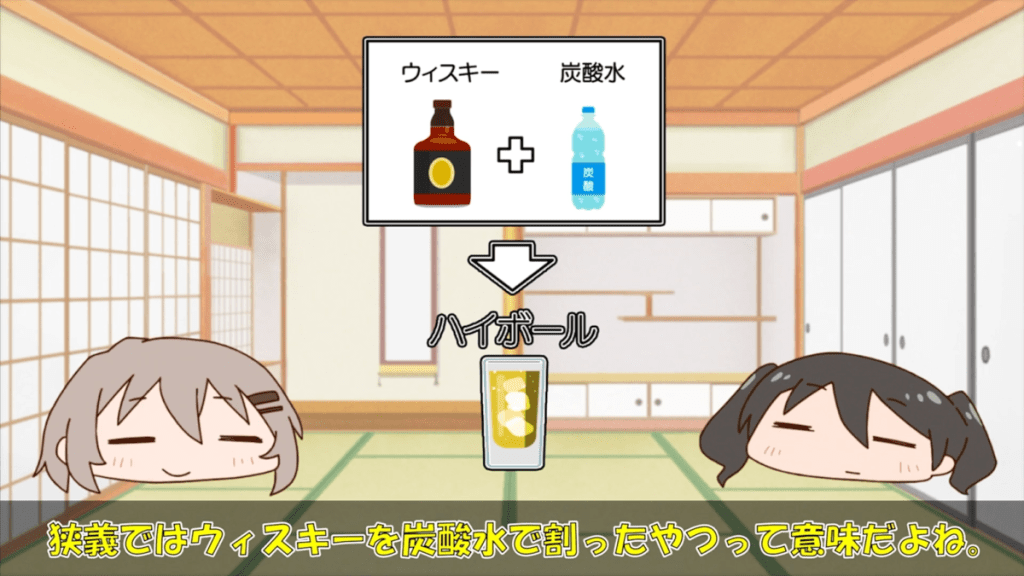
Highball: in Japan, synonymous with whisky and soda, rather than an umbrella term for a combination of spirits and mixers. Thank you Aoi and Hinata from Yama no Susume
A central theme throughout is the myriad dichotomies of adult life—the volatility of romance and friendships, the vague form of Honne and Tatemae, and the contradictions of dreams and reality—all of these complexities explored through its peculiar “T” of “CGDCT”, alcohol. Peculiar because the dark liquor is often treated as this mythical entity in anime: giddy grown-ups who are never serious because they’re always drunk out of their minds, lucky sukebes seeing his love interests’ risqué side from them eating a few rum truffles, or your boilerplate tragic backstory of the protagonist being abused by the parent with a drinking problem. Point is, intoxication is almost never brought up in a earnest manner, either working as an excuse for some cheap laughs and fan service or a serious condition entirely incorrigible for the sake of drumming up tension.
Yet, even as its genre roots would suggest otherwise, Botan Kamiina Fully Blossoms When Drunk interfaces with the subject with a level of sincerity rarely seen elsewhere. Constantly invoked is the idea of the Dutch courage, giving our cast an on-ramp and off-ramp for initiating intimate conversations, teasing advances, and honest confrontations, all the while casting a shadow of doubt over the genuineness of their actions. The show consistently plays with this unique dynamic to paint, for lack of a better word, Schrödinger’s cat-ness of the mind, capturing the the contradictory of being through not just thoughts, but also in the way the characters behaves.
Kanade’s oxymoronic relationships is the cornerstone of the show in this regard. It’s her sincere friendship with fierce romantic rivalry Botan, the film-watching, game-playing, whiskey-infusing while talking about their common crush. It’s the awkward but still close and friendly terms with Ibuki, the hikes and catching up over drinks even after the brutal rejection. It’s the affinity but hesitancy when it comes to Jinran, the stiff flirting and deep, sombre talks at the bar. And ironically, its by putting on display this complexity of the psyche—the peppy, the wistful, the melancholic simultaneously—that relationships between the characters and their daily lives become that much more lived-in, authentic, and potent than compared to its peers.
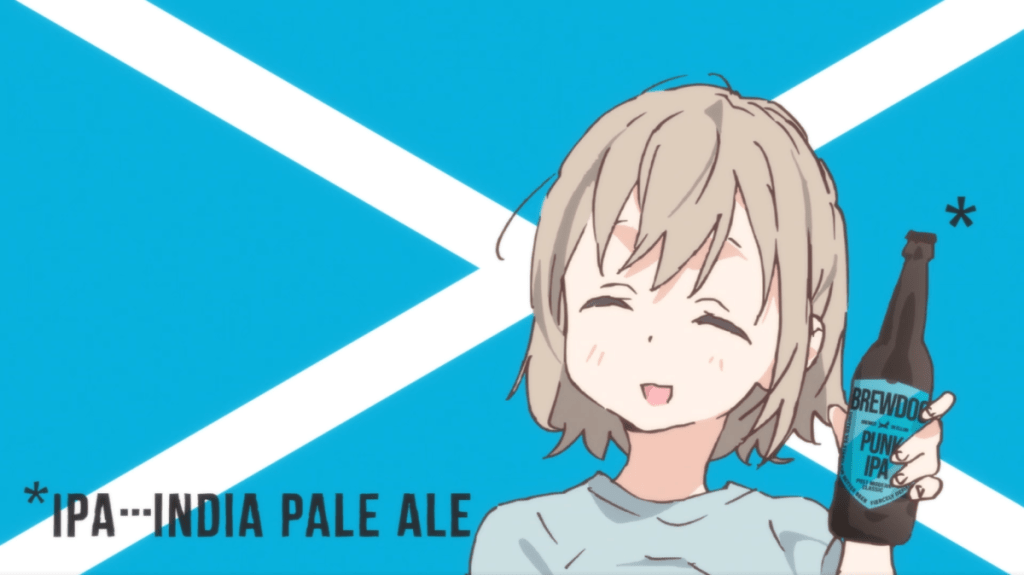
Punk IPA: flagship beer of British brewery and pub giant BrewDog, infamous for its overpriced menu items and horrendous treatment of its workers
Despite its monolith of a central motif, however, the show’s portrayal of life is, true to form, opaque and disjointed. Completely missing is any semblance of a unifying plot: a common goal that the cast is working towards together, a shared interest that everyone bonds over, or a school club that they are all part of. Instead, it’s completely reliant of on anecdotes and respective themes ebbing and flowing that, again, epitomises the experience of adulthood.
Where Botan plays the role of the “incorruptible soul” stereotypical of the genre, her purity acts not as a healing force that rids unkind thoughts, but a mirror that leads others face what her relentless earnestness reflects inside them. Be it Ibuki’s trauma, Kanade’s jealousy, Yaeka’s over-possessiveness, or Akane’s apprehensions, Botan’s beaming presence is both precious but also emotionally demanding. Attempt after attempt after attempt, Jinran gently waltz into Kanade’s heart with the aid of alcohol, but it was their shared appreciation of the arts that gave them the final push to set sail. And despite Yaeka’s personal grievances about Akane’s obsession with music, she also adores her passion and supports her pursuit, always there to chase her gloom away.
Botan Kamiina Fully Blossoms When Drunk manages to skip between these vastly different subjects in a decidedly coherent manner. It achieves this by deliberately obfuscating the characters’ state of mind: scenes told without internal monologue, catch-22s present that renders choices a futile exercise, trains of thought literally cut off and stopped midway in its tracks. Leaving true intentions up for interpretation allows the show to be about everything, all at once; the liminal spaces between themes connected through this lingering sense of inconclusivity, creating this hyper-literal art-imitates-life narrative that it’s difficult to put into mere words.
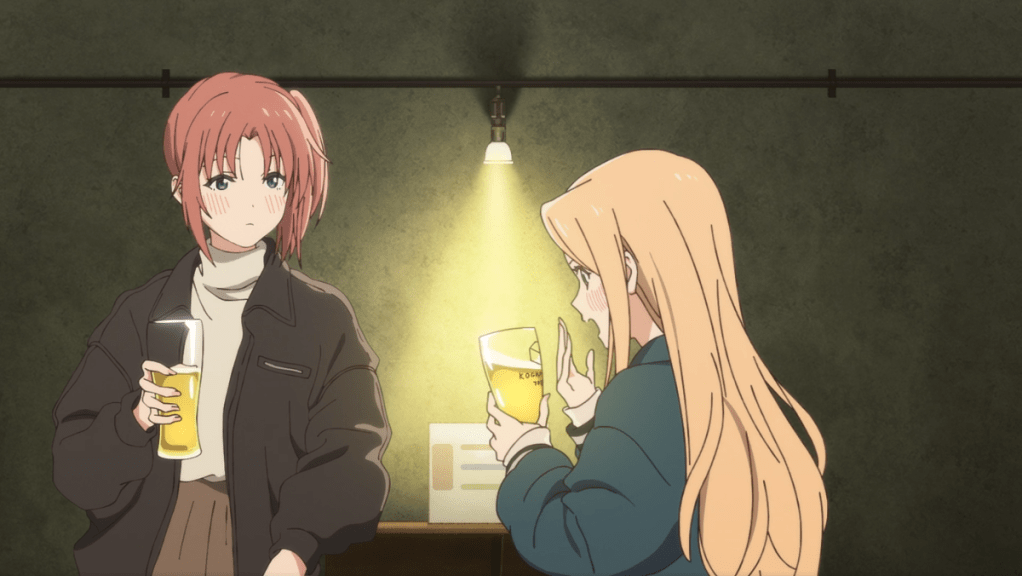
Weizenbier: aka wheat beer, brewed by replacing portion of malted barley with malted wheat, resulting in a lower IBU. In the picture, “Forest” brewed by Bathe Yotsume Brewery
Where words prove profoundly inadequate, the amazing team of animators with Soigne’s bohemian attitude towards the industry norm of consistency has filled in the gaps. The visual language of Botan Kamiina Fully Blossoms When Drunk drives much of its characterisation and the depth of its world. It boasts on social media (Twitter/X) and blog posts about the scouting of actual locations featured, but more importantly, the wide array of talent and changing roster weekly, and it’s not hard to see how each of the teams’ idiosyncrasies elevates each and every episode.
Miyachi’s principled attitude towards character design in episode 1 sets the solid foundation to build on; Matsuo Yuusuke’s solo key animation with their signature free-flowing line work and tactfully exaggerated character movements in episode 2 magnifies expressiveness and moe, a subtle but substantive change that lures in audience further; Gin-san’s avant-garde, Shaft-esque style in episode 3 throws a spanner into the works, but manages to maintain the main duo’s emotional distance while encapsulating the peculiar energy of its source material; Makimo Hidenori’s gorgeous renderings and Tozawa Shuntarou’s jaw-dropping storyboards and blocking in episodes 4 and 5 rises to the occasion for the two most dramatic episodes of the series yet; Morotomi Naoya her key animation team’s liberal take on facial expressions and character movement in episode 6 serves as the perfect showcase for Jinran’s first appearance; Kuremizu Kousuke’s use of ambience and the background of the everyday to echo characters’ mood in episode 7 helps fill in the gap where dialogue couldn’t; Okubo Shunsuke’s more mature rendition of the cast in episode 8 is a match made in heaven for its tonal shift towards tackling the real worries of grown-ups; Shirasaka Hideaki’s script combined with Tanaka Hironori’s role as storyboarder, animation director, and episode director provides the concentrated vision needed to deliver the climax that is episode 9; Okuda Yoshiko’s exquisite lighting paired with Matsumoto Norio’s amazing character animation in episode 10 gives off a subdued vibe fit for both the flourishing romance between Kanade and Jinran as well as the quiet grudges and confidence that defines Akane and Yaeka’s relationship; Ueno Souta’s out of this world backgrounds and bold shot composition in episode 11 captures the feeling of blooming love between our now two couples; and the whole team coming together for the powerful finale in episode 12 is nothing short of poetry in motion.
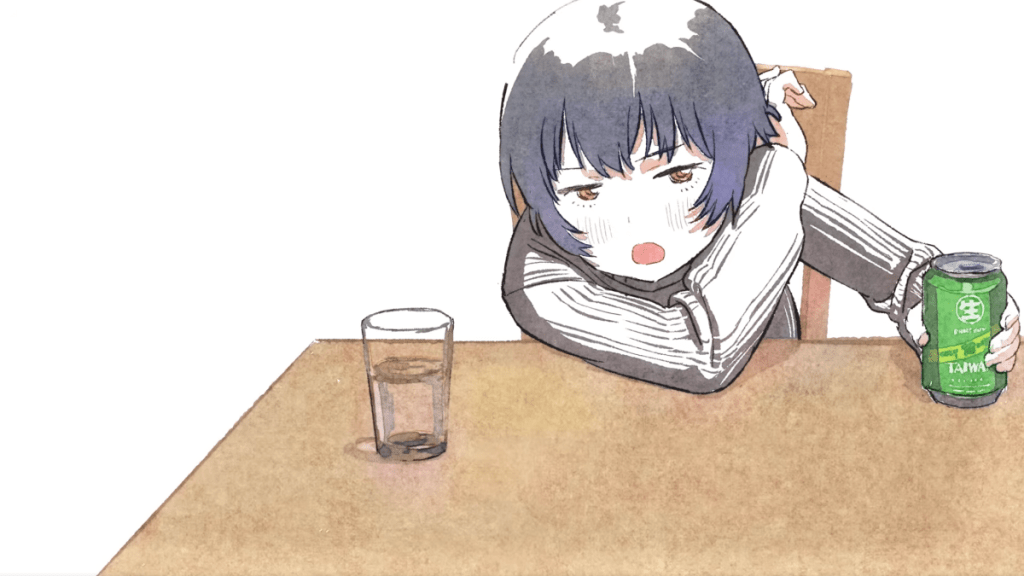
Taiwan Beer: produced by state-owned Taiwan Tobacco and Liquor Corporation using short grain Penglai rice, imposed to the island during Japanese rule during WW2. But still, please go try their Lychee fruit beer, truly out of this world. Please go try their Lychee fruit beer, truly out of this world
Beyond its production masterclass within its 20 minute runtime, Botan Kamiina Fully Blossoms When Drunk further reinforces the three-dimensionality of the cast and world with its crème de la crème 4:3 opening and 12 unique water coloured endings by Yoshinari Kou (episode 1’s below). At the end of each episodes are 90 seconds of dazzling sequences that exposits backstories and hints at small details for keen eyes to follow. This approach lets the show have cake and eat it too. It avoids being too bogged down by exposition without sacrificing character depth, all the while the reality of never being able to understand someone except from the stories they tell you.
I won’t bore you by going through them one by one again, but it would be criminal to not to highlight some of the standouts. The ending of episode 5 tells the tale of Kanade and Ibuki’s first meeting, how Kanade finds and loses her colourful world. But within it also are references galore: Kanade’s camcorder used for recording the OP, the aftermath of Ibuki’s traumatic experience first shown all the way back in episode 1, Botan and Kanade’s shared first impression of Ibuki in episode 4, the same shot of Gifu mountain later hiked in episode 7. The ending of episode 9 shows the prelude episode 5’s B-part, juxtaposing and parrallelising Botan’s confession that just passed with Kanade’s to great effect. Not to mention the various endings that fleshes out Kanade, Akane, Yaeka, Jinran, and Ibuki‘s past.
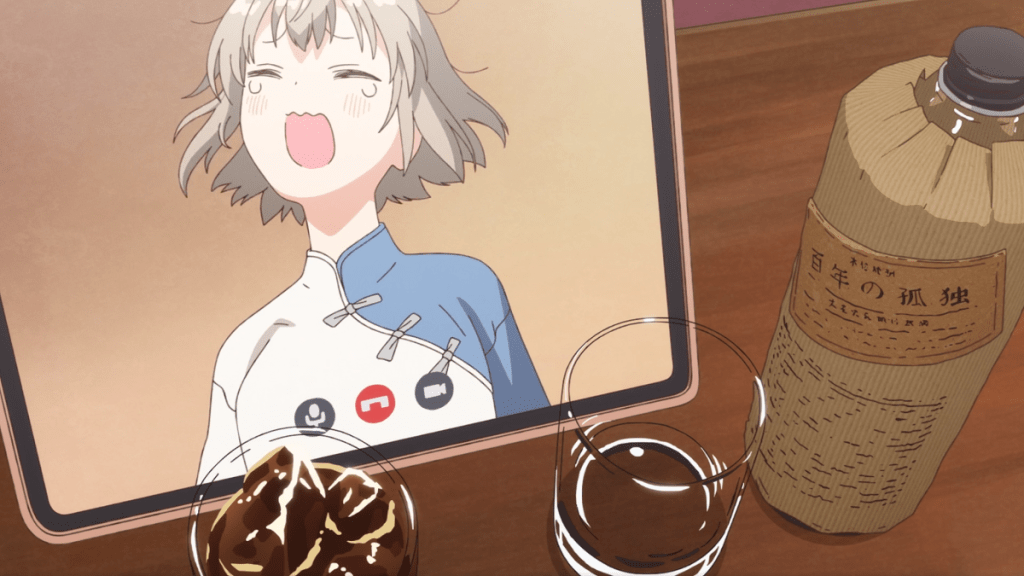
Hyakunen no Kodoku: A brand of pure barley Shochu brewed by Kuroki Honten in Miyasaki, est. 1885. I would add a snarky comment except I know nothing about this drink.
It’s rare that I find myself at a complete lost for words for a show that I absolutely adore, and it is not lip service. Three scrapped drafts later is what you have been reading right now, an unfiltered, hazy, and jumbled rumination. But if there is one takeaway from Botan Kamiina Fully Blossoms When Drunk, is that life doesn’t wait for perfection. Accept your foibles, come to peace with failings, and move on. A beautiful world still awaits.


Leave a Reply