
first published 2026/09/27 on Anilist
A lukewarm defence of Mushoku Tensei
It is naive to think that one can write compelling fantasy without at least a basic understanding of history and politics. A fictional world isn’t just exciting because of its intricate magic systems, grandiose conflicts between kingdoms, or a hero’s triumphant journey; more pertinent to making a world feel lived-in lies in its dialectics: its systems of oppression and how the masses navigate them, its racial dynamics and how it affects every person’s class, wealth, and status, and how those social hierarchies then in turn shapes the characters’ every action.
Mushoku Tensei has shown from the outset that it does not care in the slightest about any of the latter, in huge part because of the 34-year-old reincarnated NEET lying in the centre of the story, Rudeus Greyrat. “Blessed” by the Hitogami’s divine interventions, he proceeds to gain immense powers as a mage in his upper-middle class family living in the wealthiest nation in the realm, diddling kids and buying slaves. But as bad as it sounds, as the turning points came and went, I found myself engrossed in the series despite the myriad character flaws of Rudeus, recognising the effort put into building an actually expansive setting not earthbound, but rather informed by its own fictional history and geography own society and the people in it.
I hate to pose as the enlightened centrist, but I’d like to offer a third way between much of the internet chatter between the relentless fans and haters, who’ve either praised it to high heavens or dragged it to the depths hell. A lukewarm defence of Mushoku Tensei, if you will. Unfortunately, though, this is also where I’ll have to put up a spoiler warning for this season, so beware beyond here.
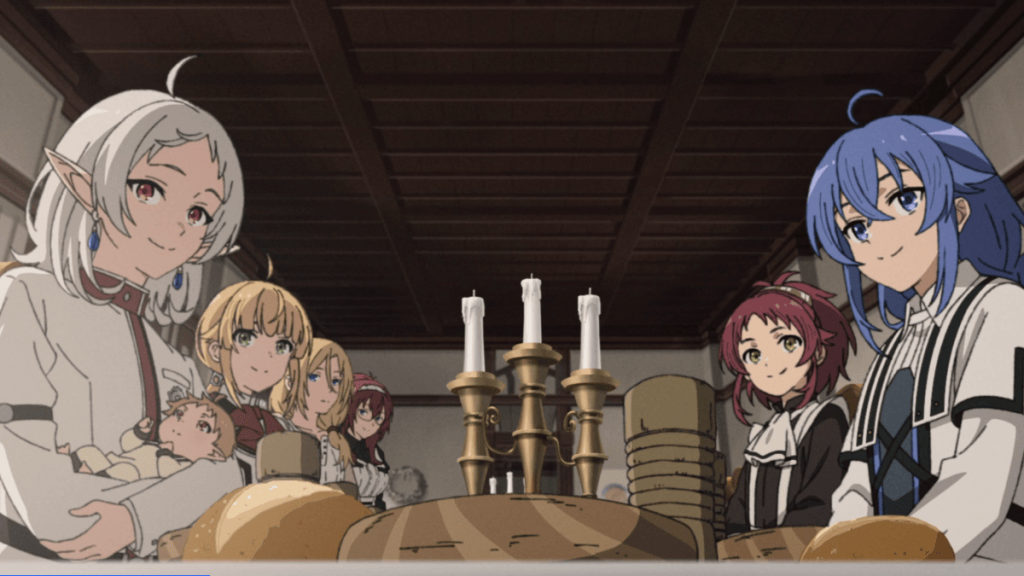
Lovely family you got there Rudeus, would be a shame if a grey rat came and messed everything up
The one thing that Mushoku Tensei continues to deliver on, in spectacular fashion no less, is its wondrous, expansive world. Season 1 was a world building masterclass, an absorbing showcase of the geography, knowledge, and inner-workings of its world; season 2 provided a continued sense of simultaneity through reuniting the various friends an foes Rudeus has met all over to the Magic University, even as the world in view has shrank; and just as it felt like the pacing had grind to a halt after back to back slice of life arcs in season 3, it hits us with, without exaggeration, one of the most memorable and well-planned twists of all time. Alternative universe Oldeus’ brief cameo leaves behind a lasting sense of gravity that not only recontextualises all previous encounters with Hitogami, but carries consequences that ripples through the rest of the series, and one that will no doubt be remembered well through shock factor alone.
It’s a one trick pony, sure, but it is one hell of a trick. No matter what you think of Mushoku Tensei’s questionable morals, indistinctive female leads, or overall rancid vibes of its protagonist (and they are huge caveats, but we’ll get to this later), there’s no denying that it captures the imagination and satiates the thirst for exploration and the fantastical like no other. A lot of this is thanks to how profoundly relevant each detail and every story beat is, turning points or not: Ruijerd’s backstory seemed like throwaway material until it isn’t, Perugius’s castle in the sky was but a fairytale told to children until we get to visit 50 episodes later, and Nanahoshi’s understated by decidedly weighty appearance doesn’t make sense until her role in the story becomes clear.
The pinnacle of it all culminated in this season’s turning point. Think back to the times when Hitogami actually appeared in front of Rudeus. First when convincing him to bring Ruijerd Superdia together on his journey, then desperate interferences (naming their team Dead End to scare Roxy away, advising him to find the demon eye to make sure they don’t cross paths, and bring along Ruijerd just as insurance) at Wind Port in the Demon Continent so they would brush pass each other, and his recommendation to stay in university to marry pet duo Lineana and Pursena in lieu of reuniting with family and friends in the Begaritt Continent to save Roxy and his mother. With Turning Point 4, everything snaps into focus. These moments of anagnorisis are what makes Mushoku Tensei, but whether it is makes up for all sins is another conversation all together.
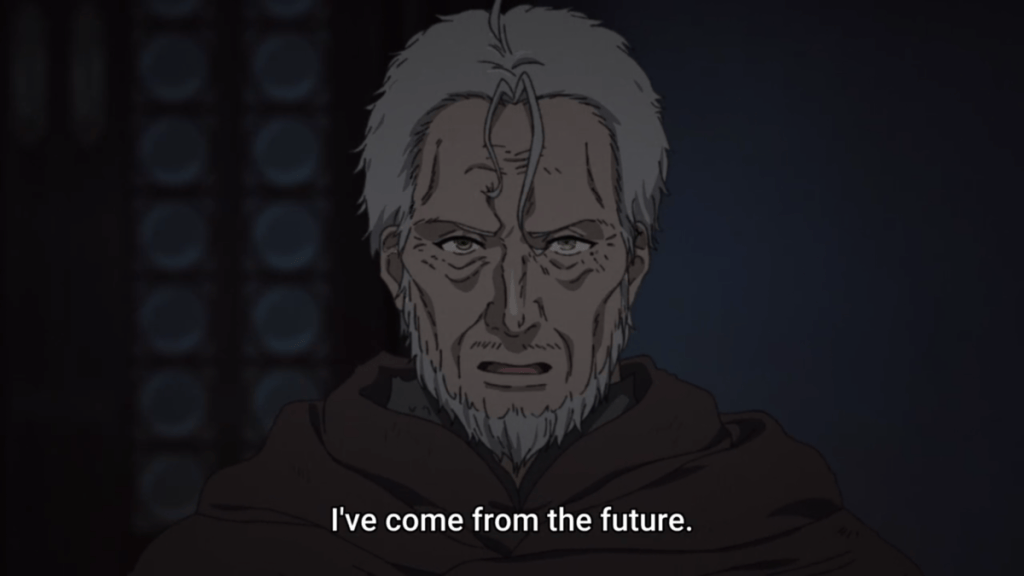
Know that although I’m about to take huge digs at the show, Oldeus is a brilliant addition that I haven’t been able to stop talking about ever since I first read it three years ago
When the show does retreat back to the daily lives of its characters, especially Rudeus’, it can’t help itself but let the rampant misogyny and general conservative bigotry seep in. The warning signs were early and plenty—from grooming to paedophilia, to slavery to adultery—Mushoku Tensei really wore their politics up their sleeves, intentionally or not. What makes season 3 the tipping point, however, is how so much of these (with the benefit of the doubt) “subconscious” leanings have come home to roost and affected the quality of it’s world itself.
This is where I risk a controversial opinion: despite the many hardships the story puts Rudeus through, its world ultimately accommodates all of his worst traits. Yes, it’s true that the challenges he faces are of epic proportions and the consequences for failure harsh. First teleported from his sheltered family home in lush fields into the barren land of demons, then brutalised and murdered by the embodiment of terror in their trek back home, followed by losing his father in a strenuous dungeon crawl to save his amnesiac mother, and to top it all off antagonised by the literal god of the universe and has his entire family killed in an alternate timeline. These are great narrative tools, not least because of their scale and stake that helps invoke a sense of otherworldliness, but it’s also a moot rebuttal to the actual point I’m trying to make.
Namely, everything is infinitely malleable so long as Rudeus gets to be seen as a sympathetic, popular figure. Slave trading is fine, having sex with under-aged children you groomed is fine, cheating on your pregnant wife is fine. When considered individually and with an unreasonable amount of good faith, they could be treated as part of the quirks of world building, since there are sufficient Thermian justifications for all of the above. But once you notice the pattern—that the world bends to his will and enables everything that’s wrong with his character—you can’t unsee it.
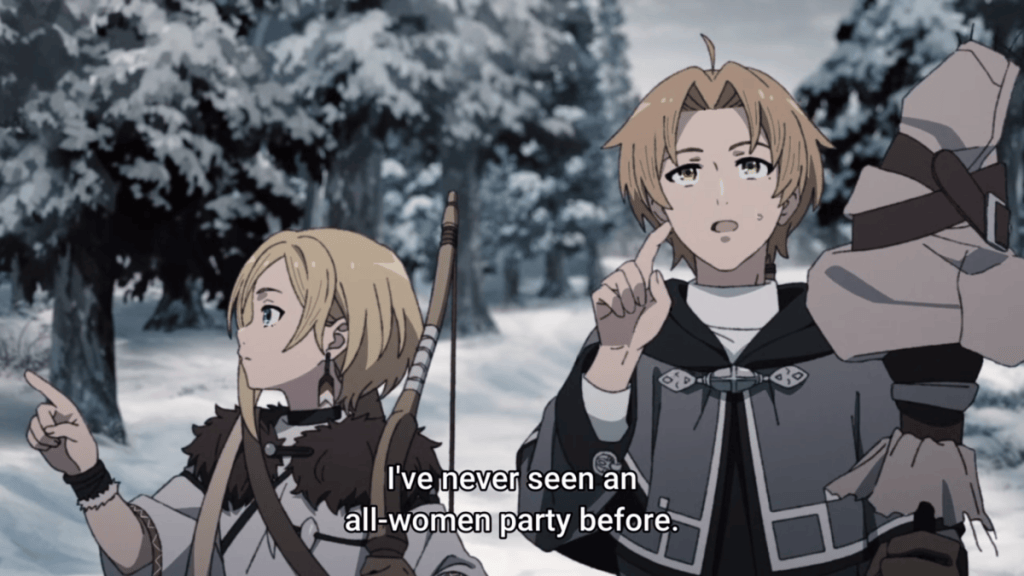
“I guess you stop seeing them over rank C people look for skill over gender”, Sara added. Just some casual misogyny thrown in for no reason whatsoever
Calling Mushoku Tensei a story of Rudeus’ redemption is beyond disingenuous because, in this six-faced world, he does not need to learn. Sara’s saga comes to a close this season by feigning the “growth” Rudeus, but the show somehow tries to put part of blame onto her too. Which is ironic given the constant commentary from Mr Gin-san. Other than the side affect of treating the audience like complete idiots who can’t read the room by spelling out every single little emotional detail, the mere sound of his voice is a constant reminder that Rudeus is a 34-year-old man reborn who should know better, whereas at the opposite end is a girl deep in the teenage angst, hurt by her horrible first experience.
But the worst victims are no doubt his wives/love interests, who are now caricatures of their past selves devoid of any character. Sylphy is monogamous until her darling says no, and henceforth turns into the polygyny advocacy demon; Roxy is an authoritative figure only in name, but is otherwise reduced to a petite woman who exists solely to praise and elevate Rudeus’ abilities by comparison; and even when miles away from Rudeus, Eris’ entire schtick is idolising a predator, even improving on her sword skills involved thinking about him, truly one of the lamest fails of the Bachdel test in recent memory. While thankfully Eris isn’t doomed as a character (yet), Sylphy and Roxy has already permanently brain broken post-marriage that conforms to Rudeus’ desires, of cute, subservient, and loyal wives.
To portray these tropes so uncritically are already inherently harmful, but even if you’re the kinds of nutters that doesn’t care about the real life implications of fiction, they diminish the very magic that its world holds. The allure of great fantasies is that its imaginative setting allows for thematic explorations from different perspectives, but when the characters and narrative constantly endorses the oppression in real life, with its form and function unaltered, its effectiveness inevitably fades. Mushoku Tensei world is, again, admittedly impressive. But dare I say, it does less than nothing with it, and that’s all because the author’s (or lack there of) beliefs.
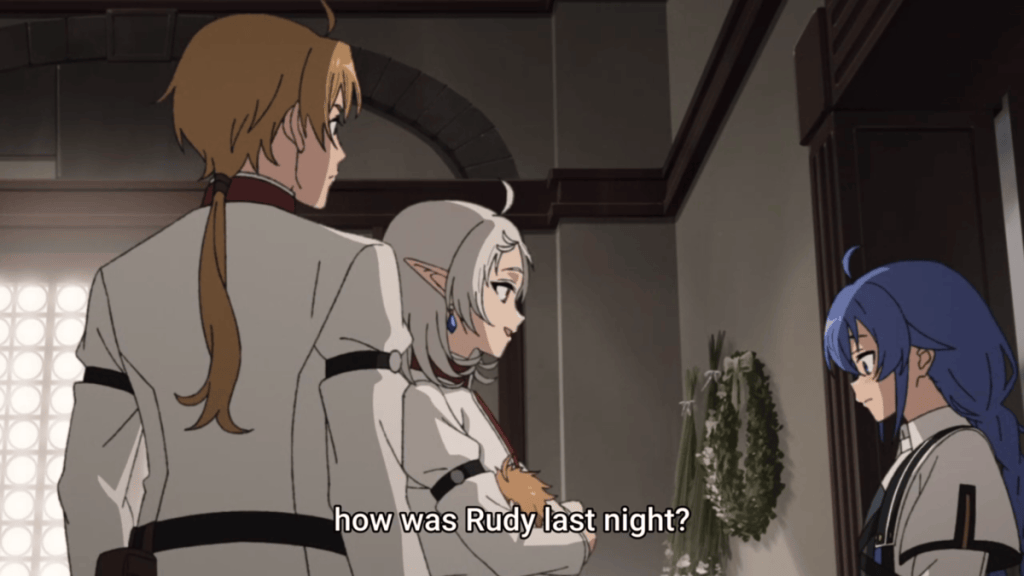
Like, how can you not wince at this scene of Sylphy asking Roxy how sex was with Rudeus last night?
I don’t claim to know for sure Rifujin no Magonote’s politics, but if I were to make a profile of him, it’d be this. This is a man who is shaped by his narrow media palette (i.e., male-oriented otaku subculture) and has never stopped for one second to consider that perhaps his biggest influences are not an all-encompassing and neutral force, but rather informed by very real material and ideological contexts. The result is an anime that feels increasingly flat, even as our heroes are meeting new and reuniting with old friends and foes alike; because by adopting so many of the medium’s tropes unfiltered, every second in its world is becoming a reminder of reality: it is becoming ordinary.
Yet, despite everything, I can’t help but find _Mushoku Tensei_ somewhat endearing for what it is: a snapshot in time of a landscape now lost. Nowadays, the sludge that comes from deriving from Narou-kei no longer even pretends to say or do something profound and elaborate.
Even if only for all its fantastical twists and turns, this six-faced world is still worth witnessing till the very end.


Leave a Reply